What RBI Is Telling Banks About AI, and Why It Matters to Your Career
RBI's message on AI is simple: use it, but keep a human in charge. What the FREE-AI framework means for banks, customers and banking jobs.
If you work in a bank, you have probably heard some version of this over the last year: "AI will take over credit decisions." Or, "Chatbots will replace the front desk."
The Reserve Bank of India has been saying something more careful. It is worth reading closely, because it shapes how banks will actually use AI, and which jobs will grow because of it.
The framework in one paragraph
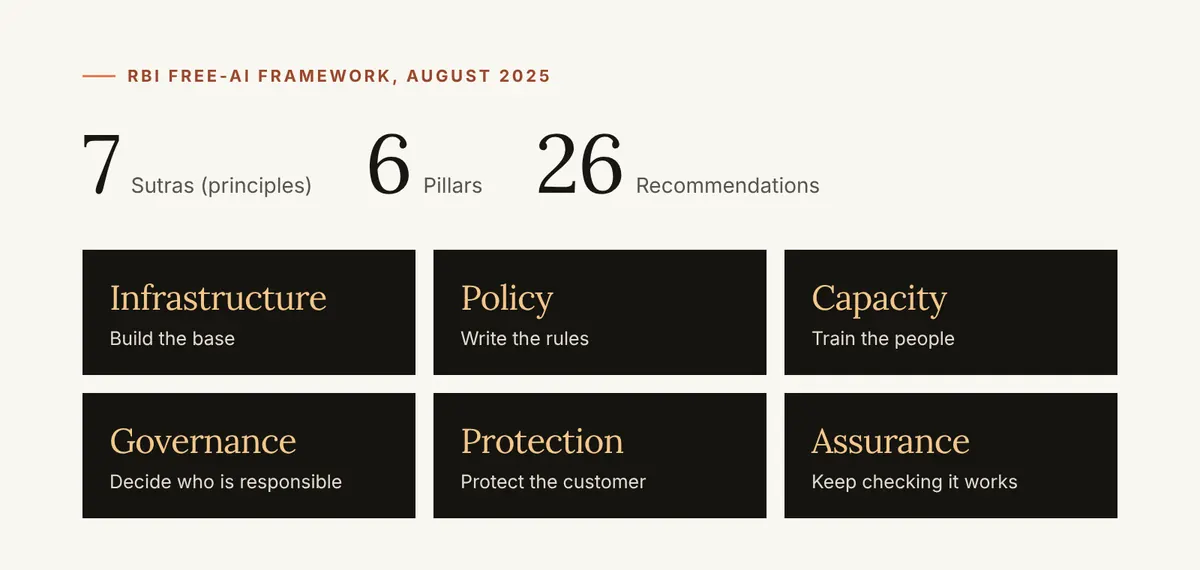
In August 2025, an RBI committee released a report called FREE-AI, short for Framework for Responsible and Ethical Enablement of Artificial Intelligence in the financial sector. It sets out 7 principles, which the report calls "Sutras", 6 pillars and 26 recommendations.
The six pillars are easy to remember: Infrastructure, Policy, Capacity, Governance, Protection and Assurance. Put simply: build the base, write the rules, train the people, decide who is responsible, protect the customer, and keep checking that it all works.
"Human intervention remains necessary"
That line is from RBI Deputy Governor Shirish Chandra Murmu, speaking in August 2026, as reported by CareerIndia. RBI's September 2026 bulletin repeated the idea. AI can help with credit, fraud detection and customer service, but banks have to validate their models properly, keep monitoring them, and be clear about who is accountable when something goes wrong.
For a customer, this matters in a very ordinary way. If a model flags your transaction or scores your loan application, the bank cannot simply say "the system decided". Somebody has to own that decision.
What changes inside a bank
AI is already common in three places:
- Credit: models that score applications or flag accounts that look risky.
- Fraud: systems that spot unusual transactions as they happen.
- Service: chatbots and voice bots that handle routine questions.
Under RBI's approach, each of these needs testing before it goes live, regular checks afterwards, a way to explain its decisions, and a person who can step in. That is more work, not less. And more work of this kind means new jobs.
The roles that are growing
According to CareerIndia, banks and financial firms are now hiring for roles such as:
- Model validators, including for large language model applications
- Model risk and AI audit specialists
- Risk-tech and MLOps leads, who keep models running and watched
Public sector banks are moving too. Indian Bank has advertised AI specialist posts this year, and SBI has announced plans to hire AI specialists.
These new roles sit between technology and risk. The banking knowledge is the part that is hardest to teach.
If you are a banker, where do you start?
You don't need to become a data scientist. The people most in demand understand how a loan file or a branch process really works, and also how an AI model can go wrong. A practical way in:
- Learn how a credit or fraud model reaches a decision: the inputs, the score and the cut-off.
- Read a summary of the FREE-AI report. It is written for the industry, not only for technologists.
- Practise checking AI output against rules and policies you already know well.
- Take one process at your workplace and write down exactly where a human must stay in the loop.
The bottom line
RBI is not against AI. It wants banks to use it carefully: tested, monitored, and with a person answerable for the result. For people already working in banks, that is good news. Demand is moving towards those who understand banking and can keep AI honest.
Sources: RBI FREE-AI committee report (August 2025), KPMG summary of the FREE-AI report, CareerIndia: RBI AI regulations and new banking jobs