AI Agents in Banking: How JPMorgan, BNY and Goldman Sachs Are Using Them to Cut Costs
$20 billion at JPMorgan, 134 digital employees at BNY, agents at Goldman Sachs. What the world's top banks reported in 2026, what AI agents really save, and the hidden cost of running them.
A year ago, most banks were still asking whether AI agents were real. In 2026 the question has changed. The world's biggest banks now count AI agents on their staff lists, measure what each one saves, and worry about how much they cost to run.
Here is what the largest banks have actually said and done this year, and what the numbers tell us.
First, what is an AI agent?
A chatbot answers a question. An AI agent finishes a job. It can read documents, check them against rules, fill in a system, ask another agent for help, and hand the result to a person for approval.
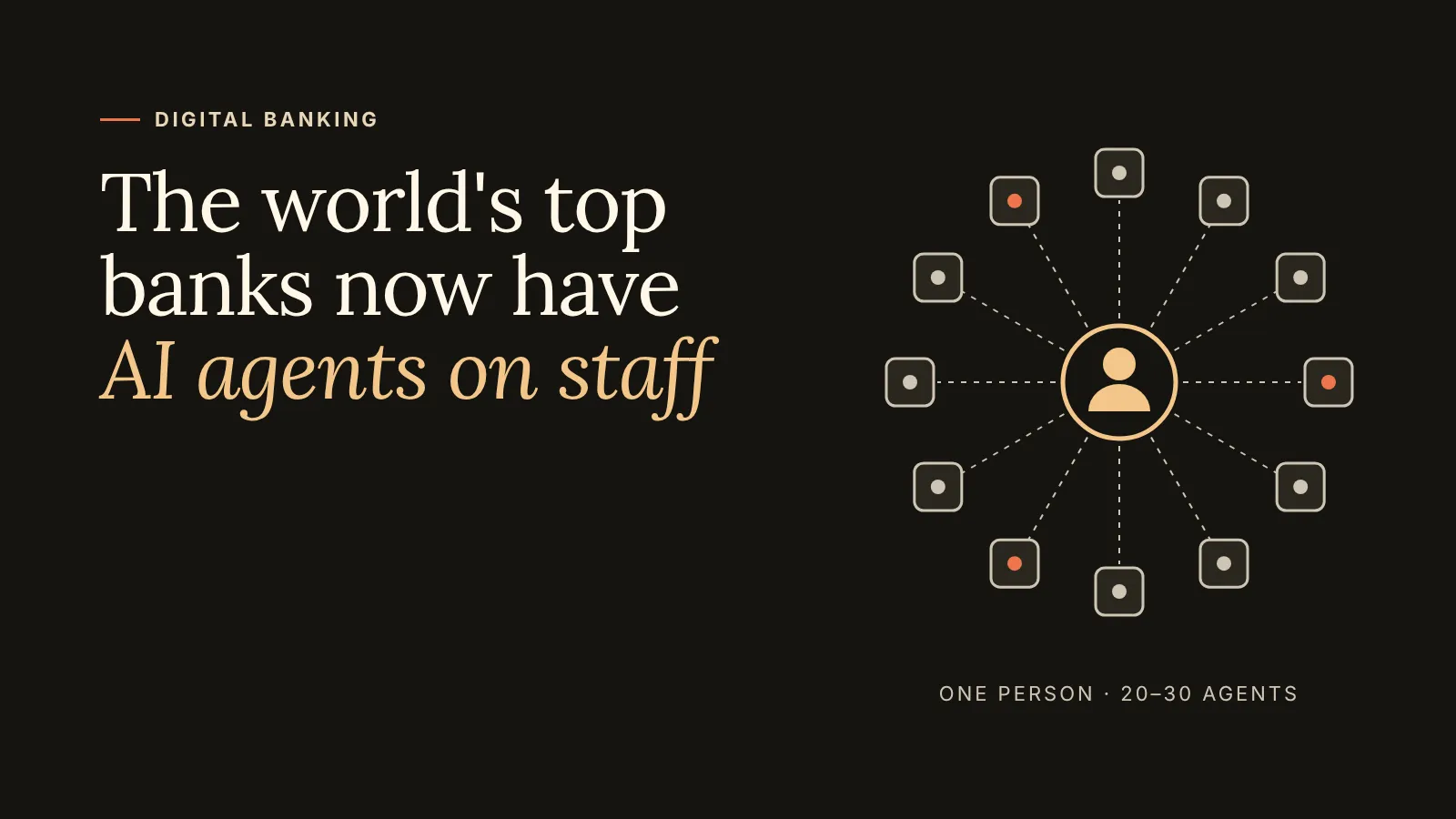
McKinsey describes a future model in which one employee oversees 20 to 30 AI agents that run complex workflows from start to finish. That is the shift banks are preparing for.
JPMorgan Chase: AI is now "the cost of doing business"
JPMorgan is the clearest example of scale. As reported in July 2026:
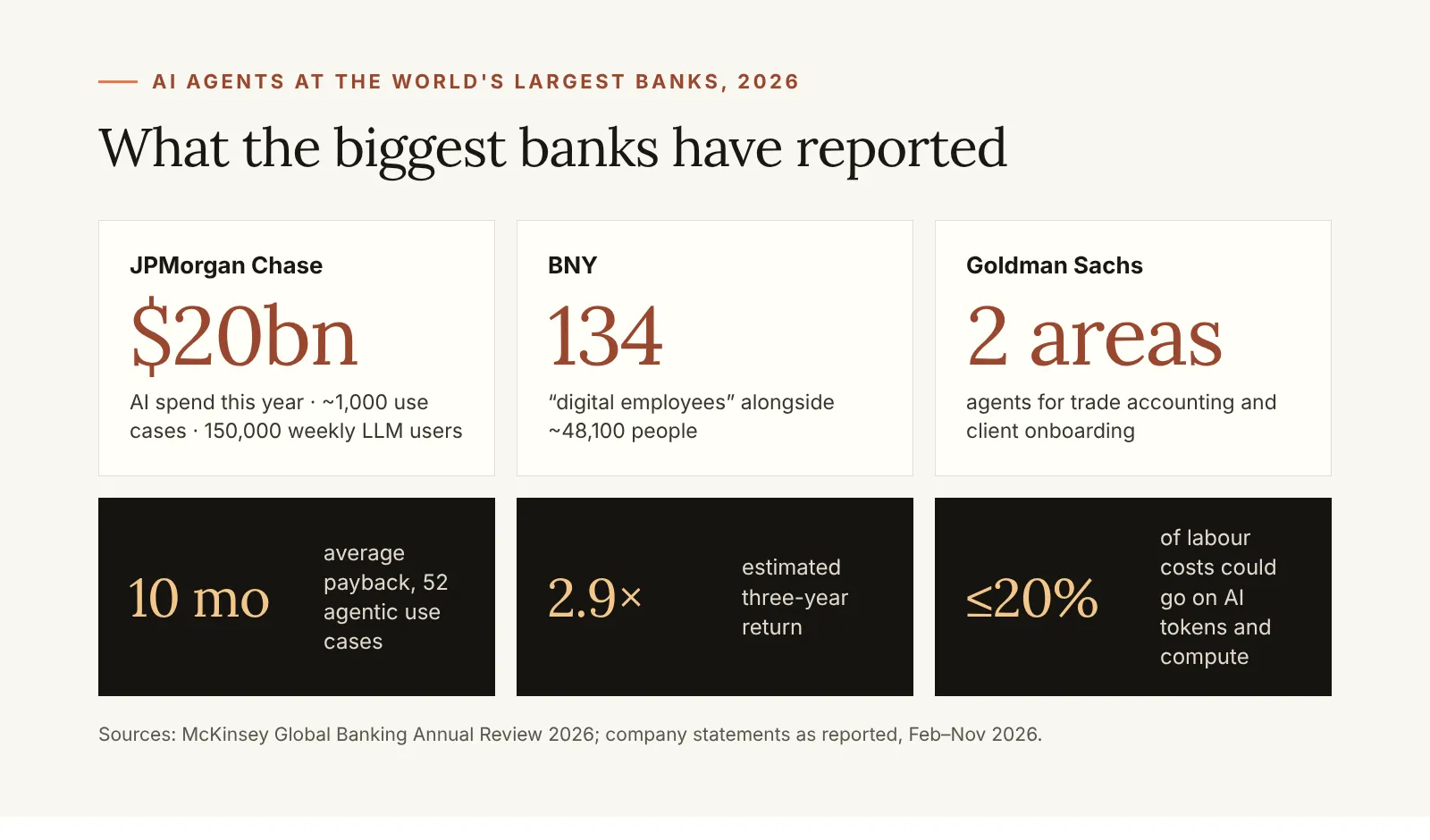
- The bank is spending about $20 billion on AI this year.
- Around 150,000 of its 300,000 employees use large language models every week.
- It runs close to 1,000 AI use cases, from back-office processing to fraud detection.
On the 14 July 2026 earnings call, CEO Jamie Dimon said some units had reduced staff numbers by 30 to 40 per cent. He did not name the units.
He also added an important warning: job cuts do not guarantee higher profits, because rivals cut costs with AI too, so margins can stay flat. In his view, AI spending is now simply "the cost of doing business".
BNY: 134 "digital employees"
BNY has gone further than most in treating AI agents like staff. As of February 2026, the bank had 134 software-based "digital employees" working alongside about 48,100 people. These digital employees now handle work that people did a year earlier.
A few more numbers from the same report:
- BNY spent about $3.8 billion on technology in 2025, around 19% of revenue.
- Nearly every employee has completed a 10-hour training on Eliza, the bank's internal AI platform.
- Headcount has fallen from about 53,400 in 2023.
Interestingly, BNY's finance chief describes AI mainly as a way to add capacity and grow with clients, not as a cost-cutting tool.
Goldman Sachs: agents as "digital co-workers"
Goldman Sachs has reportedly worked with Anthropic engineers to build AI agents on the Claude model. The agents target two areas:
- Accounting for trades and transactions.
- Client vetting and onboarding.
The bank has also given Devin, an autonomous AI coder, to its engineering teams. Its CIO, Marco Argenti, calls these agents "digital co-workers" for complex, process-heavy work, and says it is "premature" to assume direct job cuts in compliance and accounting.
What McKinsey's 2026 numbers say about savings
McKinsey's Global Banking Annual Review, released in November 2026, studied 52 agentic AI use cases in banking. Its findings:
- Average payback of about 10 months on the investment.
- An estimated three-year return of about 2.9 times.
- 80% of companies in McKinsey's 2026 State of AI survey reported productivity gains for individual employees, but only 6% said AI drove a significant share of their profits (EBIT).
In its 2025 review, McKinsey had estimated that AI could cut banks' net costs by up to 20%. It also warned that competition would likely pass much of that saving on to customers.
The catch: agents are expensive to run
Here is the part most headlines miss. AI agents talk to each other, and every exchange uses tokens, the units AI models charge for. McKinsey says spending on AI tokens, computing and operations could reach up to 20% of a bank's labour costs.
Banks are responding in three ways:
- Setting up dedicated teams, which some call "AI FinOps", to control AI spending.
- Being more selective, putting agents only where the expected return is strongest.
- Measuring revenue growth, not just productivity, to judge whether the spending is worth it.
McKinsey senior partner Vik Sohoni noted that older cost controls, such as sending simple questions to cheaper models, stop working "when AI agents are working".
Customers are ready, up to a limit
McKinsey surveyed about 46,000 retail banking customers worldwide. Among those who use AI, 72% would let a banking agent carry out a financial task for them. But most would cap what it can approve on its own at around US$500.
That tells banks something useful. People want help, but they want a person, or at least a clear rule, in charge of larger decisions.
What this means if you work in a bank
The pattern across JPMorgan, BNY and Goldman Sachs is the same:
- Routine, document-heavy work is moving to agents first: onboarding checks, reconciliations, servicing requests.
- People are moving towards supervising, approving and handling exceptions.
- Banks are investing heavily in training. BNY's 10-hour Eliza course is one example.
The bankers who will do well are the ones who learn to brief an agent clearly, check its work quickly, and know when a case needs human judgement.
*Sources: McKinsey Global Banking Annual Review 2026 (as reported by Reuters/The Standard, 10 November 2026, and ANI/Free Press Journal, 16 November 2026); Cyber Daily (22 July 2026) on JPMorgan; InvestmentNews (9 February 2026) on BNY and Goldman Sachs; Banking Dive (31 October 2025) on McKinsey's 2025 review.*