AI Agents Are Now Doing Real Office Work. Here's What That Means for Your Job
A survey of 20,000 people shows AI moving from chat windows into everyday office tasks. What actually changes for working professionals, and what to learn first.
Two years ago, most of us used AI the way we use a calculator. Open it, ask something, copy the answer, close it.
That is quietly changing. In many offices, AI is no longer just answering questions. It is being handed small jobs to finish on its own: pulling numbers from ten emails into one sheet, drafting the weekly status note, checking a long document against a checklist. This is what people now mean when they talk about AI agents.
What the numbers say
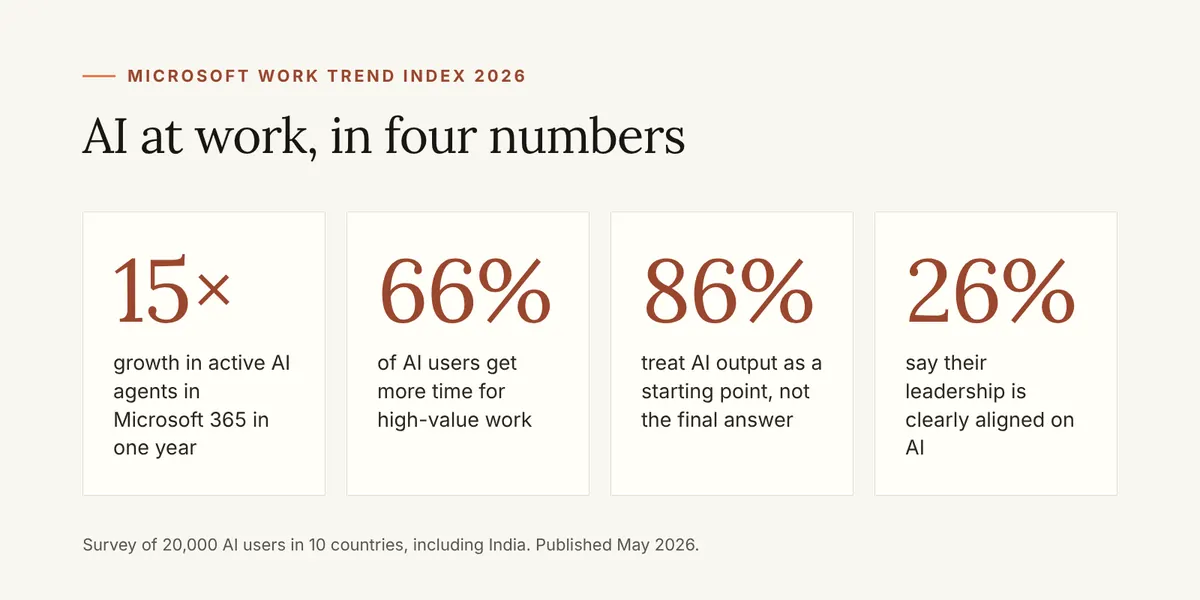
Microsoft's 2026 Work Trend Index, published in May, surveyed 20,000 people who already use AI at work, 2,000 in each of ten countries. India was one of them. A few findings stand out:
- Active AI agents inside Microsoft 365 grew 15 times in one year, and 18 times in large companies.
- 66% of AI users said AI now gives them more time for high-value work.
- 86% said they treat what AI gives them as a starting point, not a final answer.
- Only 26% said their company's leadership is clearly on the same page about AI.
That last number is the one to notice. The tools are arriving faster than most organisations know what to do with them.
So what is an "agent", in plain words?
A chatbot waits for your question. An agent is given a goal and a few permissions, and it works through the steps by itself.
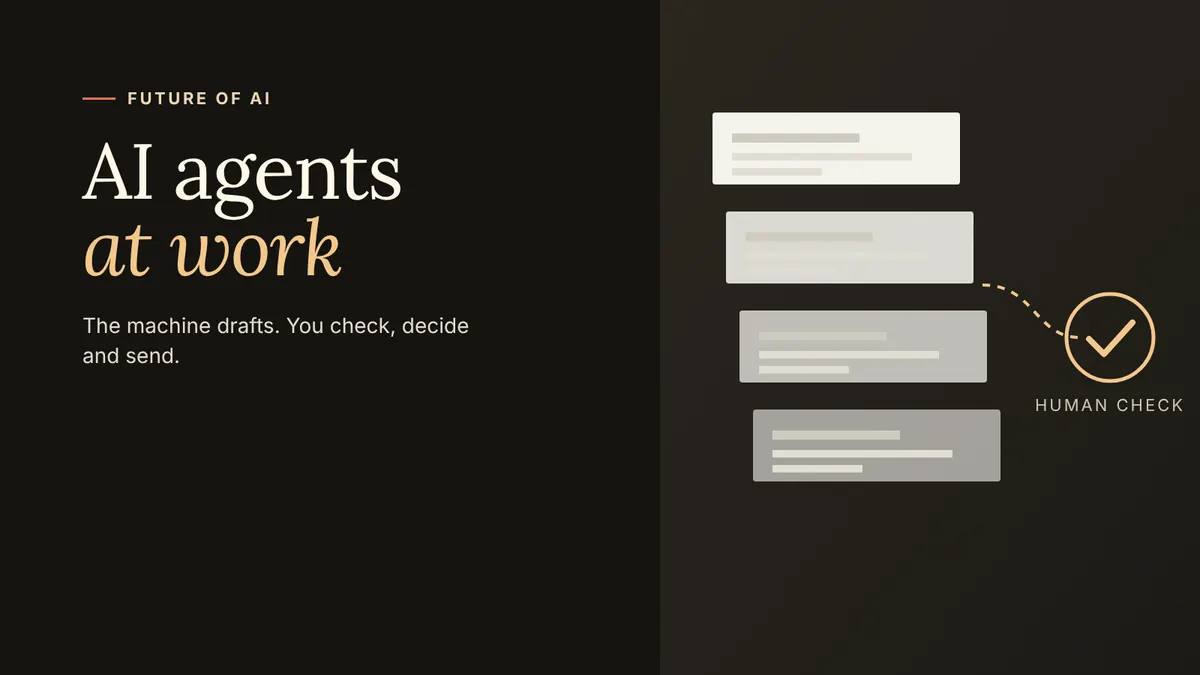
Take something every sales team or branch knows. Every Monday, someone collects last week's numbers from four different reports, puts them in one format and mails a summary to the manager. An agent can be set up to do the collecting and write the first draft. A person still reads it, fixes what looks wrong and presses send.
That split, where the machine does the first 80% and a human owns the last 20% and the decision, is where most real use sits today. Not robots replacing teams. Mostly, the boring first draft disappearing.
The skill that matters most is not prompting
When Microsoft asked people which human skills matter most when working with AI, the top two answers were checking the quality of AI output (50%) and critical thinking (46%).
Anyone can type a request. The person who looks at the answer and says "this figure is from last quarter" or "this clause doesn't apply to our clients" is the one whose value goes up.
The heaviest users in the survey, about 16% of people that Microsoft calls Frontier Professionals, did something a little surprising. They were more likely to keep doing some work without AI on purpose, so their own skills don't get rusty: 43%, against 30% of everyone else.
Use AI to go faster, not to stop thinking.
Where your manager fits in
One finding is easy to miss. People got far more out of AI when their manager used it openly, set clear quality standards for AI-assisted work and left room to experiment. According to the report, these team and company factors mattered more than twice as much as anything an individual did alone.
If you lead a team, that is the practical lesson. Use the tools yourself, where your team can see it. Then agree on three simple rules: what AI can draft, what a person must always check, and what should never go into an AI tool at all, like customer data.
Try this for the next four weeks
You don't need a course to start. Pick one task that repeats in your week and do this:
- Write down the steps you follow today, in order.
- Ask an AI tool to do the first draft of only the first two or three steps.
- Check every line, and note what it got wrong.
- Keep the parts that genuinely saved time. Drop the rest.
- Never paste customer, client or confidential company data into a public AI tool.
A month of this will teach you more about agents than a dozen articles about them.
The bottom line
AI agents are not taking whole jobs overnight. They are taking the dull first draft out of many small tasks. The people who do well will be the ones who learn which work to hand over, check the result properly, and spend the saved time on what still needs a person: judgement, relationships and decisions.
Source: Microsoft Work Trend Index 2026