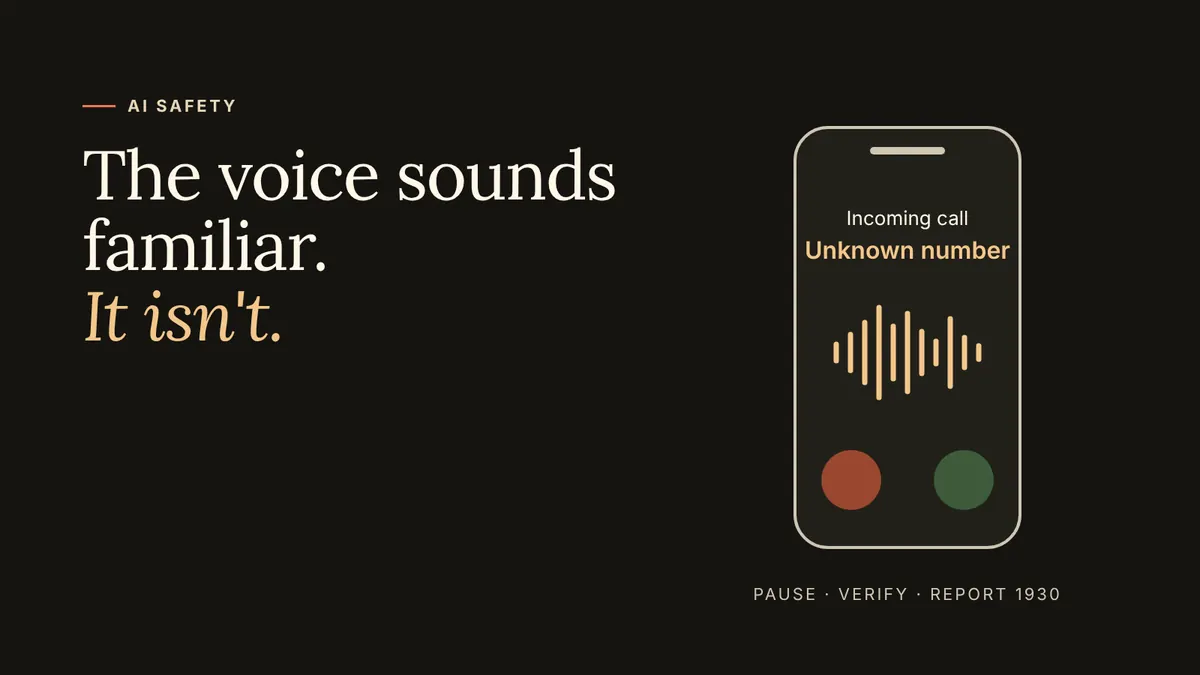
The call comes late in the evening. It's your son's voice, or your father's, and he sounds frightened. There's been an accident, or some trouble with the police, and he needs money right now. Please don't tell anyone. Please hurry.
A few years ago, the voice alone would have been proof enough. Today it isn't.
What has changed
AI tools can now copy a person's voice from a short recording, the kind many of us share without a second thought in a WhatsApp voice note or an Instagram video. Fraudsters use the copied voice to make a call feel real.
On 20 October 2026, Punjab National Bank's MD and CEO Ashok Chandra warned customers about exactly this. He said fraudsters may imitate the voice or the appearance of family members to create a fake emergency and push people into transferring money urgently. He also warned that fake emails and SMS can look just like genuine bank messages.
How the scam usually works
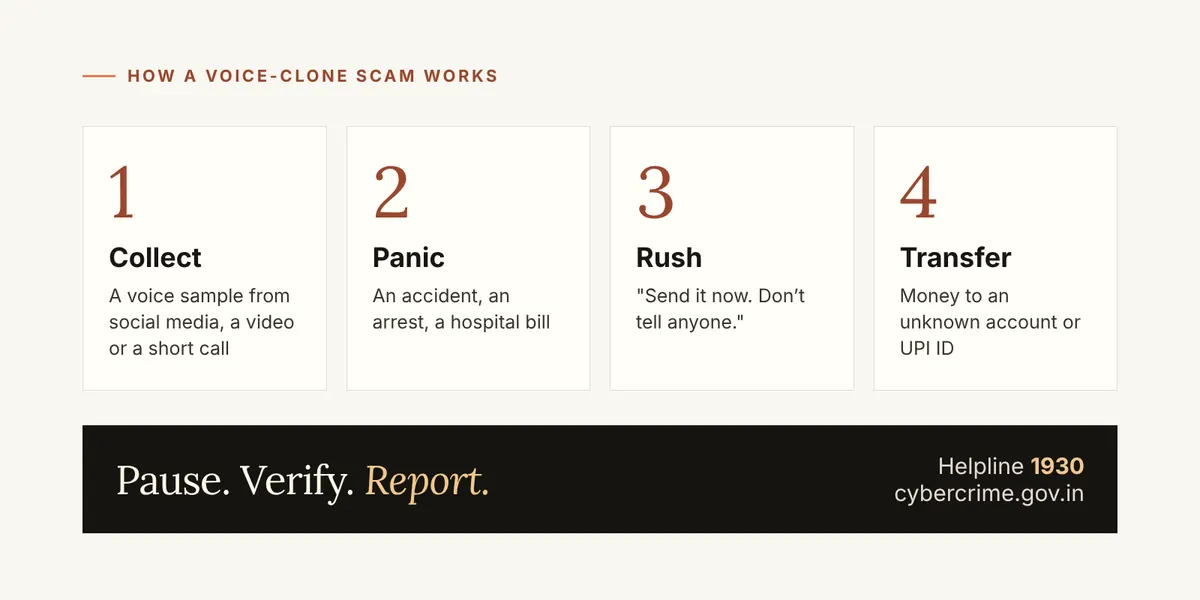
- They collect a voice sample, from social media, a video, or a short call where they keep you talking.
- They create panic: an accident, an arrest, a hospital bill, a payment stuck somewhere.
- They demand speed and secrecy: "Send it now. Don't call anyone."
- They ask for a transfer to an unknown account or UPI ID, often in several smaller amounts.
The technology is new. The trick is old. Every version depends on one thing: getting you to act before you think.
Five habits that protect your family
- Agree on a family code word. One simple word that only your family knows. If the caller can't say it, hang up.
- Call back on the saved number. Cut the call and dial the person from your own contacts, or call someone who is with them.
- Slow down on purpose. Any call that says "don't tell anyone" and "do it now" in the same breath is a warning sign.
- Never share OTP, PIN, CVV or passwords. Your bank will not ask for them on a call, SMS or WhatsApp.
- Think before posting voice and video in public. Keep social accounts private where you can, especially for older family members.
A real emergency will still be there after a two-minute check. A scam won't.
A note for bank and branch staff
A familiar voice is no longer proof of identity. When a customer calls about an urgent, unusual transfer, or an elderly customer comes in visibly anxious to send money "for a relative", it is worth gently slowing things down and asking a few questions. Sometimes a fraud is stopped at the counter simply because someone noticed the customer looked worried.
If it has already happened
Act fast. The first few hours matter most.
- Call the National Cyber Crime Helpline on 1930 straight away.
- File a complaint at cybercrime.gov.in.
- Tell your bank and ask them to block the transaction or the account.
- Report the fraud number on Chakshu, on the government's Sanchar Saathi portal.
The bottom line
AI has made scam calls far more convincing, but the defence is still simple. Pause. Verify on a number you trust. Never let urgency make the decision for you. And share this with the people in your family most likely to pick up that call.
Sources: IANS: PNB warns customers against AI voice cloning and deepfake frauds (20 Oct 2026), Sanchar Saathi: Chakshu